
MLB Betting Legalization by State: US Sportsbook Availability
 Available in US
Tracking the Expansion of Legal US Sports Betting Frameworks
I travel for work, and I learned early on that “legal” does not mean “identical.” I opened a sportsbook app in New Jersey with a full menu of props, parlays, and live betting. The next week in Washington, DC, the same app worked but the market selection was noticeably thinner. And when I crossed into Virginia, a different set of operators was available entirely. As of 2026, 38 states plus DC have legalized sports betting, but the regulatory details – what you can bet on, through which platforms, with what restrictions – differ enough to matter.
The state-by-state patchwork is the legacy of PASPA’s 2018 repeal, which gave each state the authority to legalize and regulate sports betting independently. The result: a fractured market where your betting experience depends on your zip code. For MLB bettors specifically, the differences that matter most are whether your state allows online betting (versus retail-only), which operators are licensed, and whether specific bet types like prop bets carry restrictions.
States With Full Online MLB Betting Access
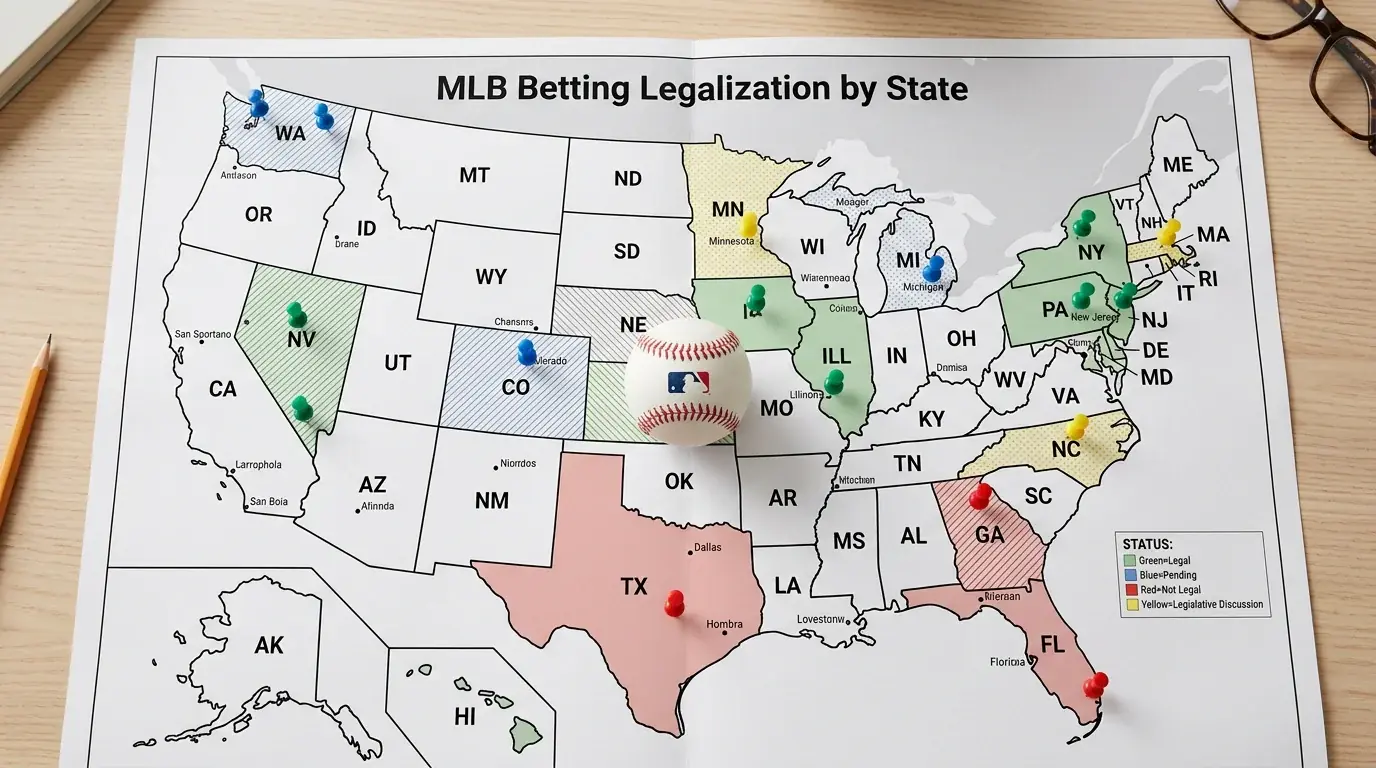
The states with the most mature and bettor-friendly markets tend to be those that legalized early and embraced online platforms. New Jersey, Pennsylvania, Colorado, Illinois, and Arizona offer full online access through multiple licensed operators, with deep prop menus, live betting, and competitive odds. Tax revenue from sports betting hit $3.71 billion in 2025, a 32.4% increase from the prior year, and the states that legalized first captured a disproportionate share.
New York stands as the highest-revenue state thanks to its population size and the heavy demand from the New York metro area, but its tax rate on operator revenue is among the nation’s highest, which theoretically translates to slightly worse odds for bettors as operators offset the tax burden. New Jersey, by contrast, has a lower operator tax rate and has consistently offered some of the most competitive odds in the country.
For baseball bettors, the most important state-level variable is market competition. States with ten or more licensed operators tend to offer the most competitive moneylines because the operators compete for market share. States with limited licenses – sometimes as few as two or three operators – have less competitive pricing. When I travel, I check which operators are available in each state and compare their MLB lines to my home-state options. The differences can be meaningful enough to affect which bets I place while traveling.
States With Pending Legislation or Retail-Only Access
Eleven states including California, Texas, and Georgia still prohibit sports betting entirely as of 2026. Several others have legalized but only in a retail format – meaning you must physically visit a casino or sportsbook location to place a bet. For baseball bettors, retail-only access is a significant limitation because MLB’s daily 15-game slate rewards the ability to react quickly to lineup news, weather changes, and sharp-money signals. Driving to a casino to bet on a 7:10 PM first pitch is not practical for most people.
California and Texas are the two most-watched states for potential legalization. California’s tribal gaming interests and Texas’s legislative dynamics have stalled multiple legalization attempts, but the economic pressure from neighboring states generating hundreds of millions in tax revenue continues to build. When these states eventually legalize – and the consensus among industry observers is that it is a matter of when, not if – the national handle will spike significantly and the competitive landscape will shift.
For bettors in non-legal or retail-only states, the practical reality is that online betting is not accessible from their home. Some bettors travel to neighboring legal states to place bets, which is fully legal as long as you are physically located in a state that permits it when the bet is placed. Sportsbook apps use geolocation technology to verify your physical location at the time of each bet.
How Geofencing and State Borders Affect Your Account
Geofencing is the technology that enforces state-level betting boundaries, and it has practical implications that trip up even experienced bettors. When you open a sportsbook app, it checks your physical location via GPS. If you are in a legal state, the app works normally. If you are in a non-legal state or standing too close to a state border, the app blocks betting activity.
43% of Americans believe sports betting legalization is bad for society, a number that has risen since 2022. That sentiment contributes to the patchwork of state-level rules that geofencing enforces. Whether you agree with the restrictions or not, they are the reality of the current market, and understanding them prevents frustrating surprises.
The border issue is real. If you live near a state line, your GPS signal can bounce between states, causing intermittent access. I have had bets blocked while sitting in a legal-state hotel room near the state border because the GPS briefly registered my location as across the line. The fix is usually moving away from the border or toggling airplane mode to reset the GPS lock. It is an annoyance, not a dealbreaker, but it is worth knowing about before you try to bet from a border town.
Your sportsbook account and balance are generally accessible across any state where that operator is licensed. If you have a DraftKings account in New Jersey, you can use the same account and balance in Pennsylvania or Colorado without creating a new one. However, the available markets and promotions may differ by state due to regulatory requirements. For bettors who travel regularly, maintaining accounts with operators that have the widest state coverage maximizes your flexibility. Your initial account setup will work across states as long as you verify your identity in your home state first, and you can check state-specific availability through the market overview for context on each state’s regulatory maturity.
Can I bet on MLB while traveling to a state where it’s legal?
Yes. If you are physically located in a state where online sports betting is legal, you can place bets using a licensed sportsbook app. The app verifies your location via GPS each time you open it. Your existing account from another state will work if the operator is licensed in both states. You must be physically present in the legal state at the time of the bet – you cannot use a VPN or other location-spoofing technology.
Will California and Texas legalize sports betting soon?
Both states have seen multiple legalization attempts stall due to competing political and commercial interests. California’s tribal gaming complexities and Texas’s legislative calendar have delayed progress. Industry consensus is that legalization is likely in both states eventually, driven by the economic pressure of neighboring states collecting billions in tax revenue. However, no specific timeline is certain as of 2026.
Created by the "Baseball Bets of the day" editorial team.