MLB Betting Odds Explained: Calculating Implied Probability
 Available in US
Converting American Odds into Accurate Probability Percentages
A few years ago I watched a friend bet $100 on a -250 moneyline favorite because “they’re obviously going to win.” The team did win. He collected $40 in profit and felt great about it. What he did not realize was that at -250, the sportsbook was implying that team won 71.4% of the time. If the true probability was closer to 65%, he was actually making a bad bet despite picking the winner. That is the core lesson of this article: the outcome does not determine whether the bet was smart. The odds do.
MLB favorites win roughly 58-62% of games historically, but the odds on heavy favorites often imply win probabilities far above that baseline. The gap between the implied probability and the true probability is where every dollar of long-term profit or loss originates. You cannot identify that gap – and therefore cannot find value – if you do not understand how to read the odds and convert them to probabilities. This is the most fundamental skill in baseball betting, and I am going to walk through it at a pace where nothing gets lost.
The American Odds Format: What + and – Actually Mean
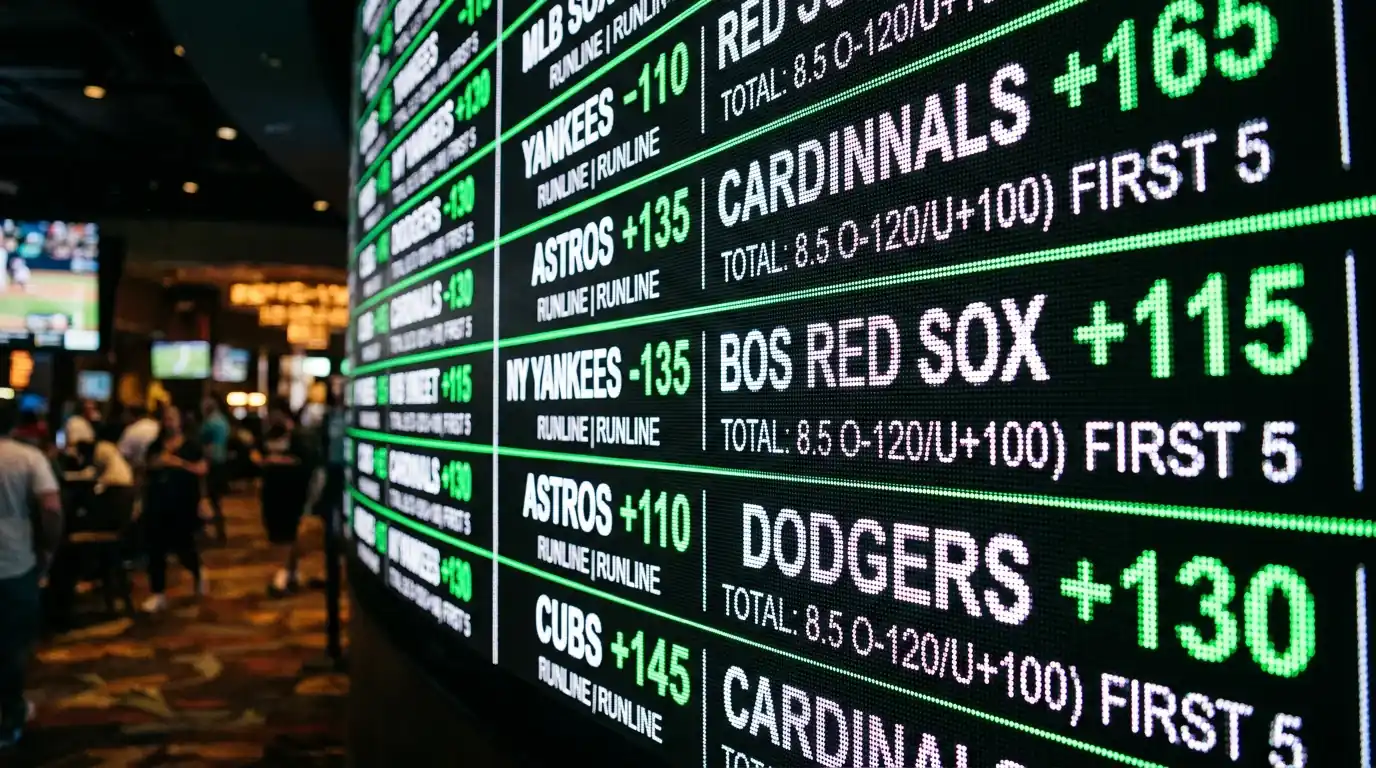
American odds are the standard format at every US sportsbook. They look confusing at first glance – a random-seeming combination of plus signs, minus signs, and numbers – but they follow a simple logic.
A minus number tells you how much you need to risk to win $100. The Braves at -135 means you bet $135 to win $100 in profit. If they win, you get $235 back ($135 stake + $100 profit). If they lose, you lose $135. The higher the minus number, the bigger the favorite and the lower the payout relative to your risk.
A plus number tells you how much you win if you risk $100. The Pirates at +120 means a $100 bet wins $120 in profit. If they win, you get $220 back ($100 stake + $120 profit). If they lose, you lose $100. The higher the plus number, the bigger the underdog and the higher the payout.
Even-money bets – where both sides are roughly equally likely – appear as -110 on both sides. The extra $10 you risk on a -110 bet (compared to an even-money +100 bet) is the sportsbook’s commission, called the vig or juice. That $10 is how the sportsbook makes money regardless of which side wins.
Let me give you a real-world example. Tonight’s game shows the Astros at -145 and the Twins at +125. The Astros are the favorite – you risk $145 to win $100 in profit. The Twins are the underdog – you risk $100 to win $125 in profit. Notice that the numbers are not mirror images. The Astros risk/reward ratio is steeper than the Twins’ because the book builds its margin into both sides. That margin is the cost of playing, and it is the reason that simply picking winners at a 50% rate loses money.
Converting Odds to Implied Probability in 10 Seconds
This is the skill that transforms you from a casual bettor into an analytical one. Every set of odds implies a specific win probability. When you can calculate that probability in your head, you can instantly assess whether a line offers value.
For minus odds: divide the absolute value of the odds by (the absolute value of the odds + 100). The Astros at -145: 145 / (145 + 100) = 145 / 245 = 59.2%. The sportsbook’s line implies the Astros win this game 59.2% of the time.
For plus odds: divide 100 by (the odds + 100). The Twins at +125: 100 / (125 + 100) = 100 / 225 = 44.4%. The line implies the Twins win 44.4% of the time.
Notice that 59.2% + 44.4% = 103.6%, not 100%. That extra 3.6% is the overround – the sportsbook’s built-in margin. In a fair market, the probabilities would sum to 100%. The overround ensures the book profits regardless of the outcome. The size of the overround varies by market and book; tighter overrounds (lower total) mean better value for bettors.
The ten-second version: for favorites, the number divided by (number + 100). For underdogs, 100 divided by (number + 100). With practice, you can eyeball it. -150 is roughly 60%. +150 is roughly 40%. -200 is roughly 67%. +200 is roughly 33%. These benchmarks let you assess any line instantly without doing formal math.
Once you know the implied probability, the question becomes: do I think this team wins more or less often than the line suggests? If the line implies 55% and your analysis says 60%, you have found value. If the line implies 55% and your analysis says 52%, you are overpaying. This comparison is the entire foundation of profitable sports betting, and it starts with being able to read the odds fluently.
The Juice: How Sportsbooks Build Their Margin
The US sports betting industry generated $16.96 billion in revenue in 2025 – a 22.8% increase over the prior year. That revenue comes almost entirely from the vig built into every line. Understanding how the juice works is understanding where your money goes and why long-term profitability requires overcoming a structural headwind.
On a standard -110 / -110 line, the book collects $110 from each side and pays out $210 to the winner. Two bets at $110 each = $220 in. One payout of $210 out. The book keeps $10 per pair, or about 4.5% of the total handle. That 4.5% is the minimum hurdle rate you need to clear to break even. If you win exactly 50% of your bets at -110 odds, you lose money. You need to win 52.4% to break even and above 53% to start profiting.
MLB moneylines carry variable juice. Instead of -110 on both sides, you might see -145 / +125 or -180 / +155. The overround on these lines is often higher than on standard -110 spreads, which means the hurdle rate is steeper. At -145 / +125, the overround is 3.6%, implying a hurdle around 51.8%. At -180 / +155, the overround climbs to 4.8%, making profitability harder.
The practical takeaway: always calculate the overround on any line before betting. Two sportsbooks might offer the same team at -145, but if one book has the other side at +125 and the other book has it at +130, the second book offers a lower overround and a better deal. Shopping for the lowest overround across books is one of the simplest ways to reduce the structural drag on your profitability, and it costs nothing but a minute of comparison. That minute is worth hundreds of dollars across a season of value-oriented MLB betting.
What does -150 mean in MLB betting?
A -150 moneyline means the team is a moderate favorite, and you need to risk $150 to win $100 in profit. If the team wins, you receive $250 back (your $150 stake plus $100 profit). The implied win probability at -150 is 60%. For smaller bet sizes, the ratio stays the same: a $15 bet at -150 wins $10 in profit.
How do I convert American odds to decimal odds?
For minus American odds: divide 100 by the odds number, then add 1. Example: -150 becomes (100/150) + 1 = 1.667. For plus American odds: divide the odds by 100, then add 1. Example: +130 becomes (130/100) + 1 = 2.30. Decimal odds show your total return per dollar wagered – so 2.30 means $2.30 back on every $1 bet, including the original stake.
Created by the "Baseball Bets of the day" editorial team.